
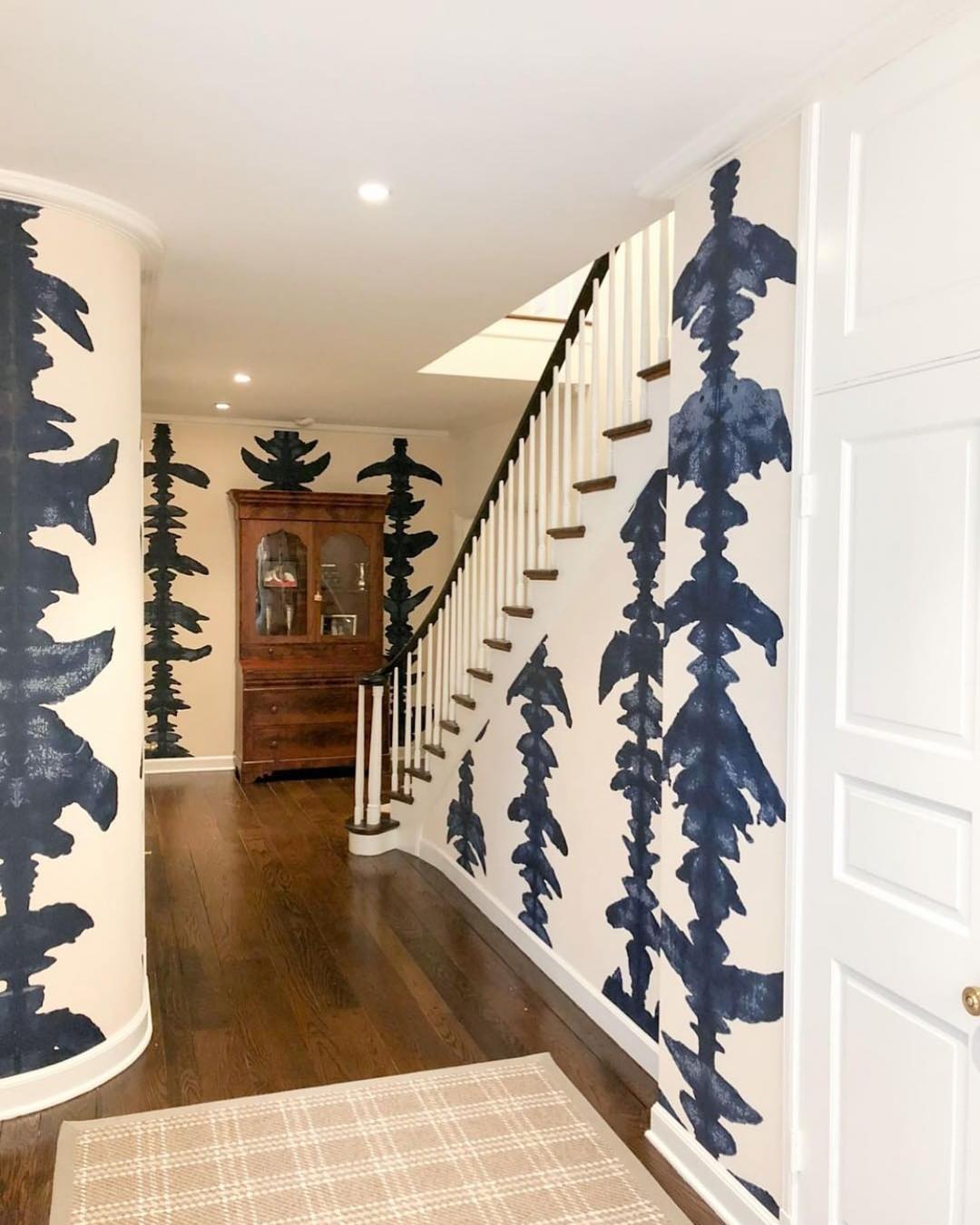
Designer wallpaper can completely transform a room. A dramatic floral can turn an ordinary dining room into a showpiece. A geometric pattern can give a home office a crisp, sophisticated appearance. A scenic wallcovering can make an entryway feel like a work of art.
But the more distinctive the wallpaper, the more important the installation becomes.
With patterned wallpaper, simply getting the material onto the wall isn’t enough. Each panel needs to work with the panels beside it so that the design flows naturally across the surface. Lines need to meet. Flowers, shapes, branches, architectural elements, and other details need to continue where they’re supposed to.
When everything is done correctly, you may barely notice where one strip of wallpaper ends and another begins.
When it isn’t, that’s often the first thing you notice.
At Mike Bradshaw Wallcovering, our experienced wallpaper installers understand the precision required when working with designer and high-end wallcoverings. Our teams serving Massachusetts and Greenville, SC approach every installation with careful planning, proper wall preparation, and close attention to details such as pattern alignment and seam placement.
What Is Wallpaper Pattern Matching?
Most patterned wallpapers contain a design that repeats at regular intervals. When multiple strips are installed next to one another, the installer must position them so that the design on one strip aligns properly with the design on the next.
This is known as pattern matching.
The distance before a design repeats vertically is generally referred to as the pattern repeat. Depending on the wallpaper, that repeat may be relatively small or quite large.
There are also several common types of wallpaper pattern matches.
A straight match has design elements that line up at the same height on adjoining strips. A drop match offsets the pattern from one strip to the next. Some drop patterns can require several strips before the complete design sequence repeats. A random match, meanwhile, doesn’t require adjacent strips to align at a particular point.
The Wallcoverings Association identifies random, straight-across, and drop matches as the three major categories of pattern matching. Understanding which type you’re working with affects how panels are measured, cut, positioned, and installed.
For an experienced wallpaper installer, determining how a pattern needs to be handled is one of the first steps—not something figured out halfway through the installation.
Pattern Matching Starts Before the First Strip Goes Up
One of the biggest differences between an experienced wallpaper installer and someone who simply knows how to hang wallpaper is the amount of planning that happens before installation begins.
You can’t necessarily start in an arbitrary corner and expect an intricate designer pattern to work perfectly around an entire room.
The installer needs to evaluate the wallpaper and the architecture together.
Where is the room’s primary focal point?
Where should the dominant elements of the pattern appear?
Where will seams fall?
What happens when the pattern reaches a doorway or window?
How will it transition around corners?
If the pattern cannot match perfectly at the point where the installation eventually comes back together, where can that transition be placed so it is least noticeable?
These are important considerations.
Professional installation guidance from the Wallcoverings Association recommends planning seam placement, focal points, doors, windows, starting points, ending points, and the eventual area of mismatch before hanging begins.
In other words, a high-quality wallpaper installation is engineered around the room.
Why Pattern Matching Matters Even More With Designer Wallpaper
Pattern alignment matters with virtually any patterned wallpaper, but the stakes can be considerably higher when you’re working with luxury and designer wallcoverings.
These materials may feature intricate illustrations, oversized florals, detailed geometric designs, metallic elements, hand-crafted characteristics, unusual textures, or large-scale motifs designed to make a dramatic statement.
And, of course, high-end wallpaper can represent a substantial investment.
If you’ve selected an exceptional wallcovering for your home or your client’s project, you want the finished installation to showcase what made that material special in the first place.
A beautiful pattern that’s noticeably misaligned can distract from the entire room.
That’s one of the reasons Bradshaw Wallcovering specializes in working with high-end wallcoverings. Our installers understand that expensive and specialty materials need to be handled carefully and installed with the precision they deserve.
Perfect Lines Make a Difference
Geometric wallpaper provides one of the clearest examples of why precision matters.
Imagine a wallpaper composed of horizontal and vertical lines. A tiny alignment error between the first few panels may not seem significant. But as the installation continues across a long wall, small discrepancies can become increasingly apparent.
There’s another complication: homes aren’t always perfectly square.
A ceiling can be slightly out of level. A corner may not be perfectly plumb. Walls in older homes can be especially challenging.
That means an installer shouldn’t simply assume the architecture provides a reliable reference point.
Professional wallpaper installation uses true vertical reference lines to keep strips straight even when surrounding walls, ceilings, and corners aren’t perfectly aligned.
At Bradshaw Wallcovering, perfect lines are one of the hallmarks of our installation work. Our experts pay close attention to every edge, seam, and alignment so that the finished wallcovering looks intentional and professionally executed.
Large-Scale Patterns Require Careful Planning
Large florals, botanical prints, dramatic geometric designs, and other oversized patterns can create spectacular rooms, but they also make planning particularly important.
Consider a wallpaper featuring a large flower, tree, bird, or other dominant design element.
You don’t necessarily want the most visually important part of that design disappearing awkwardly into a corner or being interrupted in an unfortunate place by a window frame.
An experienced installer can evaluate how the pattern relates to the wall and determine an appropriate starting position.
This is where wallpaper installation becomes as much about visual judgment as technical ability.
The objective isn’t merely to make adjacent strips match. It’s to make the overall pattern look right within the room.
Corners, Windows, Doors and Architectural Details Add Complexity
A perfectly flat, uninterrupted wall is one thing.
A real room is another.
Wallpaper installations may need to account for:
- Inside and outside corners
- Windows and window trim
- Doorways
- Crown molding
- Baseboards
- Electrical outlets and switches
- Built-ins
- Fireplaces
- Alcoves
- Sloped ceilings
- Stairways
- Architectural details
Each feature can affect where wallpaper panels and patterns fall.
Corners are especially important because they’re rarely perfectly square. An installer has to maintain the integrity of the pattern while also accommodating the actual architecture of the room.
These challenges become even more apparent when wallpapering an entire room rather than creating a single accent wall.
Eventually, the installation has to come full circle.
A skilled installer anticipates that from the beginning.
Pattern Matching Can Affect How Much Wallpaper You Need
Pattern repeat isn’t only important for appearance. It can also affect material requirements.
With some wallpapers, a portion of each strip may need to be trimmed or effectively sacrificed so that the next panel begins at the correct point in the pattern. The larger or more complicated the repeat, the more material may be required to achieve proper alignment.
That’s one reason we encourage homeowners and interior designers to think about professional installation early in the process—particularly when ordering expensive designer wallcoverings.
Running short can be more than an inconvenience.
Wallpaper rolls are commonly identified by pattern and dye-lot or run numbers. Different production runs can sometimes have slight differences in color, coating, embossing, or other characteristics. Ordering additional material later therefore may not always be as simple as purchasing another roll.
An experienced installer can help identify potential material requirements and installation considerations before work begins.
Wall Preparation Is Part of a Beautiful Pattern Match
Pattern alignment may be what you see, but the quality of the wall underneath the wallpaper plays an important role in the finished result.
Wallpaper doesn’t automatically make wall imperfections disappear. Depending on the material, imperfections can become quite noticeable once the wallcovering is installed.
That’s why excellent preparation work is another important part of our installation process.
Before wallpaper goes up, the wall needs to provide an appropriate surface for the particular wallcovering being installed. Existing wallpaper, damaged drywall, rough patches, cracks, poorly finished repairs, and other conditions may need attention.
A smooth, properly prepared surface helps the wallpaper lay as intended and contributes to the clean, lasting finish you expect from a professional installation.
What Does Poor Pattern Matching Look Like?
Unfortunately, mistakes with patterned wallpaper can be difficult to ignore once you know they’re there.
Problems may include patterns that don’t line up across seams, horizontal elements that appear to rise or fall across the wall, large design elements awkwardly cut off at focal points, obvious seams, inconsistent spacing, or an unfortunate mismatch in a highly visible part of the room.
With geometric wallpaper, even a small error can be particularly noticeable.
With scenic or highly detailed designer wallcoverings, an installation mistake can interrupt the artwork itself.
Correcting the problem isn’t necessarily as simple as moving the wallpaper after the fact. Depending on the material and adhesive, panels may have to be removed and replaced—and replacement material may be expensive.
When you’ve invested in designer wallpaper, professional installation helps protect that investment.
High-End Wallpaper Deserves High-Quality Installation
One of the easiest mistakes to make with an expensive wallcovering is concentrating entirely on selecting the material while treating installation as an afterthought.
The two really go together.
You can choose a spectacular wallpaper, but the quality of the finished room still depends heavily on how that material is installed.
That’s especially true with intricate patterns, luxury wallcoverings, murals, specialty materials, ceilings, stairways, foyers, and other challenging installations.
Expert Designer Wallpaper Installation in Massachusetts and Greenville, SC
If you’re investing in designer wallpaper, choose an installer with the experience to do justice to the material.
Bradshaw Wallcovering has teams of expert wallpaper installers serving homeowners, interior designers, and other professionals in Massachusetts and the Greenville, South Carolina area. Our installers have extensive experience working with high-end, designer, and specialty wallcoverings where precision and attention to detail are essential.
From exact pattern matching and thoughtful seam placement to careful wall preparation and navigating challenging architectural details, we approach each project with the craftsmanship that luxury wallcoverings demand.
Whether you’re planning a single statement wall, transforming an entire room, or incorporating designer wallcoverings throughout a home, Bradshaw Wallcovering can help turn your vision into a beautifully finished space.
Contact Bradshaw Wallcovering to discuss your upcoming wallpaper installation project in Massachusetts or the Greenville, SC area.